
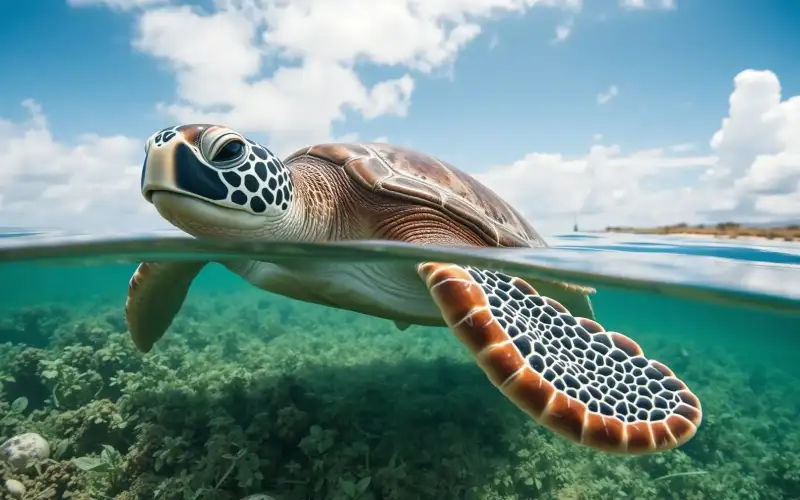
The first time I drove the dirt track down to Lara Bay — windows down, the Akamas scrub releasing that particular smell of thyme and warm limestone — I nearly missed the turtle entirely. She was already retreating to the water, a loggerhead the size of a kitchen table, moving with that unhurried, ancient purpose that makes you feel briefly irrelevant. The beach was dark. There were no crowds, no lights, no commentary. Just the sound of the sea and the slow drag of flippers across sand. I've been back a dozen times since, and that quality of silence feels increasingly precious.
Lara Bay, tucked into the western edge of the Akamas Peninsula about 14 kilometres north of Coral Bay, is one of the most significant marine turtle nesting sites in the entire Mediterranean. Every summer, loggerhead turtles (Caretta caretta) and the rarer green turtles (Chelonia mydas) haul themselves ashore here to lay eggs in the same stretch of pale sand their ancestors have used for thousands of years. The Cyprus Department of Fisheries and Marine Research estimates that Lara receives between 600 and 1,000 turtle nests each season — a number that places it among the top five nesting beaches in the region. That is not a small thing. And it is genuinely fragile.
Why Lara Bay Matters
Both species nesting at Lara are classified as endangered. Green turtles are particularly vulnerable globally, and the Cypriot population represents a meaningful proportion of Mediterranean breeding females. The Lara-Toxeftra protected area, established formally in 1989 and reinforced under EU Habitats Directive obligations, covers roughly 8.5 kilometres of coastline and extends 600 metres offshore. Within this zone, fishing, anchoring, jet-skiing and driving on the beach are all prohibited during nesting season.
The season itself runs from roughly late May through to mid-October. Females come ashore to nest between June and August; hatchlings emerge and make their run to the sea between August and October. These two windows define the rhythm of the bay and the rules that govern it. If you're planning a visit in 2026, the peak nesting activity typically falls in July, while the peak hatching period arrives in September — both are extraordinary to witness, provided you do so correctly.
"The turtles have been coming to this beach since before there was a road to reach it. Our job is simply not to ruin that." — Stavros Michaelides, volunteer warden, Lara Bay Hatchery, speaking to me in 2023.
10 Rules for Responsible Viewing at Lara Bay in 2026
1. Arrive in daylight, leave before dark — unless on a guided night visit
The most important rule is also the simplest. Turtles nest at night, and artificial light disorients both nesting females and hatchlings. A female disturbed mid-nest will often abort the process and return to the sea without completing egg-laying. Hatchlings follow the brightest horizon — in nature, that's the sea reflecting starlight. A torch, a phone screen, or headlights can send them inland to die. Unless you are part of an authorised guided night-watching programme (see point 4), leave the beach before sunset. Arrive early morning for the best chance of seeing fresh nest markings and, occasionally, late-returning females.
2. Stay behind the rope markers at all times
The Department of Fisheries installs low rope barriers around active nests and along the upper beach from June onwards. These are not suggestions. Nests can be as shallow as 40 centimetres below the surface, and a single footstep over a clutch of eggs can crack shells or compact the sand enough to suffocate developing embryos. The wardens at Lara are polite but firm. I've watched them ask a family of five to move back from a marker three times before the penny dropped. Don't be that family.
3. Use the designated viewing platform
A timber viewing platform sits at the northern end of the main Lara beach, positioned to give clear sightlines across the nesting zone without requiring visitors to walk across it. This is where you should stand during any daytime visit. The platform is modest — it holds perhaps 30 people comfortably — but it offers a genuinely good perspective on the beach's geography, the nest markers, and the hatchery enclosures. Bring binoculars. The detail you lose by standing back you gain in not disturbing anything.
4. Book a guided night watch through an authorised operator
Watching a turtle nest is a profound experience. It is also one that should only happen under the supervision of trained guides working with the Department of Fisheries. In 2026, authorised night-watching sessions at Lara operate on a limited-permit basis, typically running from late June through early August. Groups are small — usually no more than eight people — and guides use red-spectrum torches that are less disorienting to turtles than white light. Operators based in Paphos town and Coral Bay offer transfers; expect to pay around €45–65 per adult for a session that includes transport and a briefing. Booking weeks in advance is sensible; popular July dates fill quickly.
5. No white lights, no flash photography
This applies day and night, but particularly at dusk and dawn. Even during daytime visits, flash photography near nests or hatchery enclosures should be avoided — the enclosures are designed to replicate natural nest conditions, and repeated disturbance affects hatchling development. Switch your phone to silent, disable the flash, and if you must photograph, do so from the viewing platform with natural light. The images will be better for it, and the turtles will be indifferent to your presence.
6. Do not touch eggs, hatchlings or nesting females
This should not need saying, but it does. Hatchlings found on the beach during the day are almost certainly disoriented or exhausted, and the correct response is to alert a warden immediately rather than pick them up or carry them to the water. Human scent on a hatchling can affect its ability to imprint on the beach — a process scientists believe influences where females return to nest decades later. If you find a hatchling in distress, call the Lara Hatchery directly or contact the Cyprus Wildlife Society on +357 22 463 498.
7. Leave your dog at home
Dogs are prohibited on Lara Bay beach during nesting season, full stop. Even well-behaved animals on leads cause stress to nesting females and can disturb nest sites. The scent of a dog alone is enough to deter a female from completing her nest. If you're travelling with a dog and want to visit the Akamas, there are plenty of trails in the hinterland — the E4 long-distance path passes through gorgeous terrain just a few kilometres inland — where dogs are welcome.
8. Carry your rubbish out
There are no bins at Lara Bay. This is deliberate. Bins attract foxes and ravens, both of which are significant predators of turtle eggs. Bring a bag, take everything with you — including fruit peel, cigarette ends, and bottle tops. The beach is cleaned by volunteers and wardens, not by a municipal service. A single plastic bag left near the tideline can entangle a hatchling. It sounds dramatic until you see it happen.
9. Approach the beach on foot or by authorised 4WD only
The track to Lara Bay from the Coral Bay direction is rough, unpaved, and intentionally so. Driving on the beach itself is illegal year-round. If you're coming from Polis or the north, the track via Neo Chorio is marginally smoother but still requires a vehicle with reasonable clearance. Many visitors walk in from the small car park area, which takes about 15 minutes and is entirely flat. The walk is worth doing even if you have a 4WD — it gives you time to adjust to the pace of the place.
10. Respect the hatchery — it is a working conservation facility
The Lara Hatchery, operated by the Department of Fisheries and Marine Research, relocates eggs from nests judged to be at risk — from high tides, predation, or accidental disturbance — into protected enclosures on the upper beach. In a good season, the hatchery oversees several hundred nests. Wardens are present daily from June through October, and while they are generally happy to speak with interested visitors, they are not tour guides. Ask questions briefly and respectfully. Do not attempt to look inside hatchery enclosures or touch the mesh covers.
Getting There: Practical Notes for 2026
Lara Bay sits within the Akamas Peninsula National Park, which received formal national park designation in 2019 after decades of campaigning. Access from Paphos takes roughly 45 minutes by car via the coast road through Coral Bay and Agios Georgios. The last 7 kilometres are unpaved. A standard hire car will manage in dry conditions, but many rental agreements prohibit use on unpaved roads — check your paperwork before you go, or hire a 4WD specifically. From Polis, the drive via Neo Chorio is about 30 minutes on similar terrain.
| Route | Distance from Lara | Road Condition | Approx. Drive Time |
|---|---|---|---|
| Coral Bay / Agios Georgios | 14 km | Last 7 km unpaved | 45 min from Paphos |
| Neo Chorio / Polis | 12 km | Mostly unpaved | 30 min from Polis |
| On foot from car park | 1.2 km | Flat track | 15 min walk |
There is no public transport to Lara Bay. Taxis from Paphos will make the journey but may charge a premium for the rough track. Several operators in Coral Bay offer boat trips that pass the bay, which can be a good way to see the coastline without setting foot on the nesting beach at all — worth considering during peak hatching season when beach access is most restricted.
What the Conservation Work Has Achieved
It is easy to arrive at Lara Bay, follow the rules, and leave feeling vaguely virtuous without understanding what the conservation effort here has actually accomplished. The numbers are worth knowing. In the early 1970s, before any protection was in place, loggerhead turtle populations across Cyprus had declined sharply due to hunting, egg collection, and coastal development. The establishment of the protected area, combined with sustained hatchery work and community engagement, has contributed to a measurable recovery. Annual nest counts at Lara have roughly doubled since the 1990s, though researchers are careful to note that population recovery in marine turtles is slow — females don't reach sexual maturity for 20 to 30 years, meaning the turtles nesting at Lara today are the daughters of conservation decisions made in the 1990s.
The work is ongoing and underfunded. The Department of Fisheries relies heavily on volunteers, many of them international students on marine biology placements, alongside a small permanent staff. If you want to contribute beyond simply visiting responsibly, the Cyprus Wildlife Society accepts donations and coordinates volunteer placements during the nesting season. A week spent monitoring nests at dawn is, I can confirm from a single bleary-eyed morning I spent with a warden named Eleni, one of the more quietly extraordinary things you can do on this island.
"People ask me if it gets boring, counting the same nests every morning. I tell them: the day it gets boring is the day I stop." — Eleni Papadopoulou, Department of Fisheries volunteer, Lara Bay, July 2024.
A Bonus Tip: Time Your Visit for the Golden Hour
If you want the best of Lara Bay without the midday heat and the risk of accidentally disturbing anything, arrive at around 7am. The wardens are usually already on the beach by then, checking overnight nest activity. The light is extraordinary — low, golden, raking across the sand in a way that makes every ripple and turtle track visible. You'll see the night's evidence without seeing the night itself: the broad drag marks where a female came ashore, the disturbed sand above a fresh nest, occasionally a straggling hatchling being gently redirected by a warden. Bring a thermos. The drive back along the coast, with the Akamas cliffs turning pink in the morning light, is one of those journeys that makes you glad you got up early.
Lara Bay is not a spectacle. It is a place where something ancient and improbable is still happening, partly because enough people decided, decades ago, to make it their business to protect it. The least we can do, arriving as visitors in 2026, is to hold that lightly and not make their job any harder.


Comments (5 comments)