
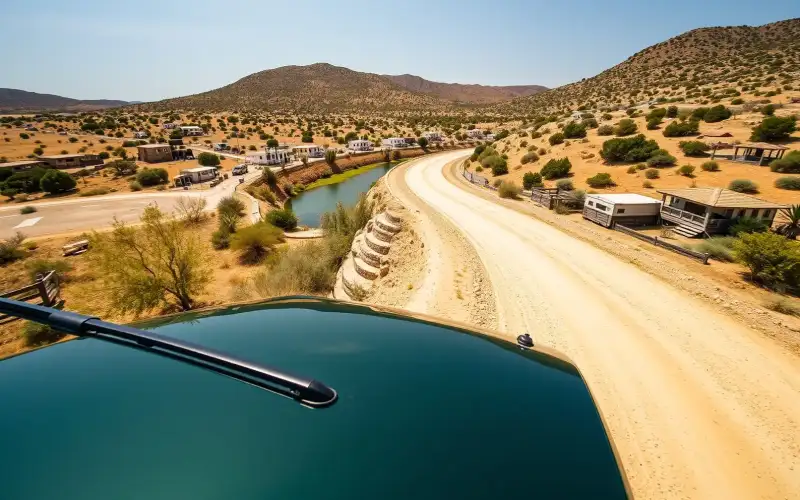
I first arrived at the Akamas Peninsula on foot, not by jeep, which was a mistake I corrected within the hour. The track simply wasn't walkable in the August heat, and the landscape demanded speed and elevation to be properly understood. Three hours later, bouncing across limestone ridges in a Toyota Land Cruiser with a quiet Paphos driver named Christos, I understood why the Akamas has become the peninsula's most sought-after adventure. This isn't a manicured safari park. It's a raw, semi-protected wilderness that reveals itself only to those willing to abandon the main roads.
The Akamas Peninsula, jutting northwest from Paphos like a weathered fist, covers roughly 230 square kilometres of scrubland, coastal cliffs, and Byzantine ruins. Most of it remains roadless in the traditional sense—which is precisely why the jeep safari has become the defining way to explore it. A standard car won't make it past the first village. A jeep, however, opens up landscapes that few tourists ever see: turquoise coves accessible only by track, shepherd's trails that haven't changed in centuries, and vistas across the Mediterranean that shift from ochre to blue depending on the light.
Understanding the Akamas: Terrain and Timing
Before choosing an operator or route, understand what you're actually driving into. The Akamas is not a jungle or a desert—it's a semi-arid Mediterranean scrubland known locally as phrygana, dotted with aromatic shrubs, wild herbs, and gnarled olive trees that have survived centuries of shepherding and neglect. The terrain is rocky, unforgiving, and utterly beautiful, especially in spring (March to May) when wildflowers—anemones, poppies, and sage—blanket the hillsides. Summer, by contrast, is brutally hot; temperatures regularly exceed 38°C, and the landscape turns monochromatic gold.
The roads, if you can call them that, are mostly compacted earth and limestone. Heavy rainfall in winter can render some routes impassable, which is why the season matters. April through October is reliably navigable. January and February see occasional closures. The best months are April, May, September, and October—warm enough to enjoy the drive, cool enough that you won't cook in the back seat.
Distance-wise, you're not travelling far. The entire peninsula is only about 50 kilometres from the town of Paphos. But the roads are slow. Expect to cover perhaps 25 to 35 kilometres in a full day, depending on the route and the number of stops. This isn't a race. It's a deliberate unfolding of landscape.
The Major Routes: What Each One Delivers
Most operators offer variations on three main routes, each revealing a different side of the Akamas. Understanding the differences helps you choose according to your interests and fitness level.
The Neo Chorio Loop (Eastern Approach)
This is the most popular route, and with good reason. It begins in the village of Neo Chorio, a working settlement of about 300 people where you'll likely stop for a traditional breakfast of halloumi saganaki (fried cheese) and bread. The track climbs steadily northward, offering increasingly dramatic views of the Chrysochava Gorge and, eventually, the coast near Lakki. The route typically covers 35 to 45 kilometres and includes stops at a traditional olive press (still functioning, still smelling of wood smoke and stone), a shepherds' shelter, and at least one coastal viewpoint where the cliffs drop 200 metres vertically to turquoise water.
The landscape here is gentler than the western routes—more rolling hills, fewer technical sections. It's ideal if you're not entirely comfortable with rough terrain or if you're travelling with older relatives. That said, it's not a theme park. You'll feel every pothole. Most operators offer this route twice daily (morning and afternoon departures), and prices typically range from €65 to €85 per person.
The Akamas Wildlife Route (Central and Coastal)
This route, sometimes called the Akamas North route, penetrates deeper into the protected area. It's longer and rougher, covering 40 to 55 kilometres, and includes stops at Lara Beach (famous for loggerhead turtle nesting, though you'll see only the nests unless you visit at night during breeding season), the Akamas Canyon viewpoint, and several traditional goat herding areas. The track here is noticeably more challenging—steeper climbs, rockier surfaces, and at least one section where you'll genuinely wonder if the jeep will make it. It will. Operators do this route 3 to 4 times weekly, typically as full-day excursions. Price range: €75 to €95 per person, often including lunch.
The Western Approach (Polis and Fontana Amoroza)
If you're based in Polis, on the western side of the peninsula, several operators offer routes that approach the Akamas from that direction. These tend to be less crowded and often include stops at Fontana Amoroza (a freshwater spring that emerges from limestone cliffs, surrounded by ferns and cooled by shadow), hidden beaches, and the village of Akamas itself—essentially a cluster of three houses and a small church, maintained by an elderly couple who have lived there continuously for sixty years. The western routes feel more intimate, less touristic. Prices: €70 to €90 per person.
The Operators: Reputation and Reliability
There are approximately 15 to 20 jeep safari operators working the Akamas as of 2026, ranging from one-man-and-a-jeep setups to larger companies with fleets and offices in Paphos town. Choosing wisely makes the difference between a memorable day and a forgettable one.
Established Operators with Strong Track Records
Akamas Experience operates from a small office in Paphos town (near the Paphos Fort) and has been running tours since 2008. Their guides, several of whom are former shepherds, know the terrain intimately and speak fluent English. They offer both group tours (maximum 6 people per jeep) and private hire. A group tour costs €78; private hire (up to 6 people) costs €360 for a full day. They're reliable, professional, and won't rush you.
Wild Pafos Adventures is newer (established 2015) but has built a reputation for smaller group sizes and more flexible itineraries. They operate from Polis and specialize in the western routes. Guides are knowledgeable about flora and fauna. A half-day tour (4 hours) costs €65 per person; full day, €88. They also offer sunset tours (€72, departing at 16:00), which is genuinely worth considering if you want to see the Akamas in different light.
Paphos Jeep Safari is the largest operator, with 8 vehicles and daily departures. They're efficient, professional, and good if you want a guarantee of availability and English-speaking guides. However, their groups are larger (up to 7 per jeep), and the experience feels slightly more commercial. Prices: €72 (group) to €320 (private, up to 6).
Smaller, More Selective Operators
If you're willing to do a bit of digging, several smaller operators offer more intimate experiences. Christos Akamas Tours (yes, the same Christos I mentioned earlier) operates a single Toyota Land Cruiser and takes no more than 4 people per tour. He speaks limited English but has an extraordinary knowledge of the peninsula's history and ecology. He's often booked weeks in advance. Full day: €350 private (up to 4 people). Contact him through local hotels or Polis town information office.
Cyprus Off-Road Adventures is based in Polis and focuses on more challenging terrain. If you want technical, rough driving and don't mind a full-day assault on your spine, this is the outfit. Their guides are younger, enthusiastic, and genuinely passionate about the landscape. Full day: €85 per person (group) or €380 private.
What to Bring: The Practical Details
This is where many first-time safari-goers get it wrong. The Akamas isn't a guided nature walk, and it isn't a beach day. You need to prepare accordingly.
- Sun protection: Bring a high-SPF sunscreen (minimum 50), a wide-brimmed hat, and sunglasses. The sun reflects off white limestone, and you'll burn faster than you think. Reapply sunscreen every two hours.
- Water: This cannot be overstated. Bring at least 2 litres per person. The jeep will provide some, but not enough. Dehydration in the Akamas is real and unpleasant.
- Closed-toe shoes: Not trainers. Hiking boots or robust walking shoes with ankle support. The terrain is rocky, and a twisted ankle means a long, painful jeep ride out.
- Light layers: Even in summer, mornings are cool, and the wind at elevation can be chilly. Bring a light jumper or fleece.
- Camera and binoculars: If you're interested in birdwatching or landscape photography, bring them. The Akamas is home to several endemic species and offers extraordinary photographic opportunities.
- Medications: If you suffer from motion sickness, take your medication before departure. The roads are bumpy. If you have any joint or back issues, mention them when booking—operators can adjust the route.
- Snacks: Most operators provide lunch (or include it in the price), but bring extra snacks—energy bars, nuts, dried fruit. You'll be grateful around 15:00.
Booking, Pricing, and Insider Tips
The best time to book is 4 to 6 weeks in advance, particularly if you want a specific operator or date. May and September fill up quickly. Prices quoted above are accurate as of early 2026, but always confirm directly with the operator, as fuel surcharges and seasonal adjustments are common.
Most operators require a minimum of 2 people per group tour and ask for payment 48 hours before departure (bank transfer or credit card). Cancellation policies vary; some offer full refunds up to 7 days before the tour, while others charge a percentage. Always ask.
A genuine insider tip: if you book a private tour (just you and a guide) rather than a group tour, you'll pay more upfront but gain enormous flexibility. You can stop anywhere, spend as long as you like at a viewpoint, and ask the guide to deviate from the standard route. Most guides are happy to accommodate requests—visit a specific gorge, stop at a particular shepherd's shelter, explore a Byzantine ruin. This flexibility is worth the extra €100 or so.
Another tip: ask your operator if they can arrange a lunch stop at a traditional village taverna rather than the packaged lunch. Most can, and it transforms the day. A meal of souvlaki, village salad, and cold wine eaten at a wooden table in the shade, overlooking the Akamas, is worth the modest extra cost.
The Landscapes: What You'll Actually See
The Akamas reveals itself in layers. In the first hour, you're still in the foothills—olive groves, scattered villages, the occasional shepherd with a flock of goats. By hour two, you're on the ridges, and the Mediterranean spreads below you, impossibly blue. By hour three, you've entered a different landscape entirely: austere, rocky, almost lunar in places, where the only sounds are the jeep engine and the wind.
Specific vistas worth noting: the viewpoint above Lakki beach offers a vertiginous drop of 200 metres, with a small sandy beach far below accessible only by foot (a scramble of about 30 minutes). The Akamas Canyon, near Lara Beach, is a narrow gorge of golden limestone where the light changes colour as you look up at the sky. The shepherds' shelter near Neo Chorio, built entirely of stone, has been in continuous use for perhaps 200 years. These aren't tourist attractions with plaques and gift shops. They're simply places that exist, and you're passing through.
Logistical Practicalities
Most operators offer hotel pickup from Paphos town and surrounding areas (Coral Bay, Polis, Kato Pafos) for an additional €8 to €15 per person. If you're renting a car, you can also drive to the meeting point (usually Neo Chorio or Polis, depending on the route) and meet the operator there. Parking is always available and free.
Tours typically depart between 08:00 and 09:00 (morning groups) or 14:00 and 15:00 (afternoon groups). Morning tours are generally preferable—you'll have better light for photography, the landscape is fresher after the cool night, and you'll finish by 15:00 or 16:00, leaving the afternoon free. Full-day tours (usually 07:30 to 17:00 or 18:00) cover more ground but are exhausting; they're best suited to younger travellers or those with genuine interest in spending an entire day off-road.
Physical fitness requirements: this is not mountaineering, but it's not passive either. You're bouncing around in a jeep for 6 to 8 hours. If you have significant back or joint issues, choose the easier routes (Neo Chorio loop) and mention your concerns when booking. Most operators are experienced with older travellers and can adjust accordingly.
When to Go, and Why It Matters
April and May are spectacular—wildflowers everywhere, warm but not oppressively hot, and the light is crystalline. September and early October offer similar conditions. June through August is hot but manageable if you start early and bring plenty of water. November through March is cooler and occasional routes may be impassable after heavy rain, but it's quieter and the landscape has a different character—greener, softer, less harsh.
If you're visiting Paphos in 2026, the Akamas jeep safari isn't optional for anyone interested in the region's natural landscape. It's the defining experience. No guided walk, no drive-and-park viewpoint, no beach visit will give you the same sense of the peninsula's scale and wildness. You'll return to Paphos dusty, tired, and sunburned, with limestone dust in your hair and an entirely different understanding of what Cyprus actually is beyond the resort beaches and tourist towns.
Comments (4 comments)