
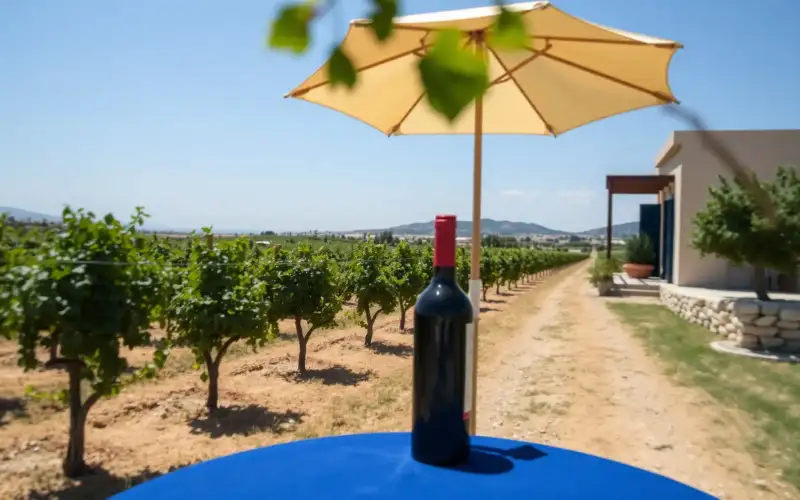
I arrived at Vouni Winery on a Thursday morning in late September, when the Paphos heat had finally begun to soften, and found Costas Christofi standing in the shade of a carob tree, holding a glass of his 2019 Xinisteri. He wasn't expecting visitors—or rather, he was, but not the kind who show up wanting to rush through a tasting in forty minutes. "You're the Telegraph writer," he said, more as observation than question. "Good. We have time." That single phrase would define the next three days of my journey through the Paphos wine region.
The Vouni Experience: Where Terroir Meets Tradition
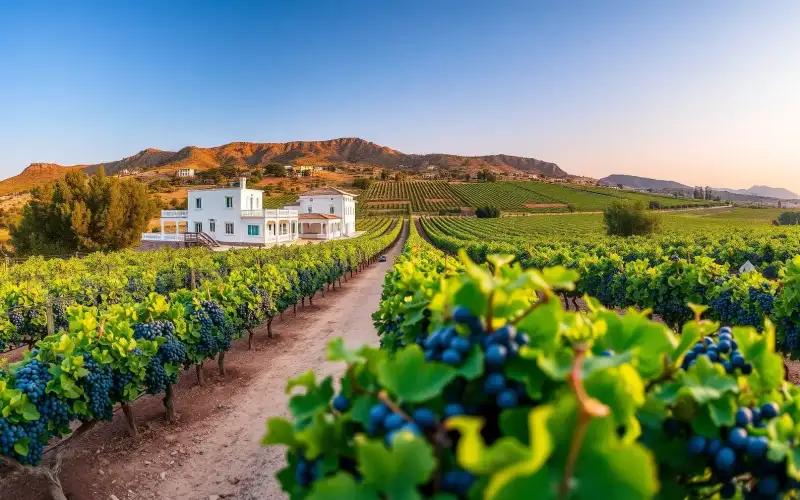
Vouni sits in the foothills above the village of Tsada, about twenty-five kilometres inland from Paphos town. The winery itself is modest—a converted stone building with a small production facility and a tasting room that opens directly onto the vineyard. There are no grand gates, no gift shop, no restaurant with sunset views. What there is, instead, is authenticity of the kind you have to search for in wine country these days.
Costas inherited these vines from his father, who planted them in the 1970s when Cyprus wine was still finding its voice. The vineyard covers roughly eight hectares, split between indigenous varieties—Xinisteri, Mavro, and Ofthalmo—and a small section of Cabernet Sauvignon planted as an experiment in the 1990s. "My father believed in the old grapes," Costas explained, walking me through the rows. "But he also believed in trying. That's the Cyprus way. We're not purists. We're survivors."
The 2019 Xinisteri I'd tasted on arrival was pale gold, almost colourless, with a mineral backbone and a finish that lingered for a full thirty seconds. It's a wine that makes you think, rather than impress. Costas poured a second glass and suggested we sit. "This is not a wine for drinking quickly," he said. "It's a wine for sitting with someone. For talking. For understanding."
We spent three hours at Vouni. We tasted five wines—the Xinisteri, a 2018 Mavro with surprising depth and black cherry notes, a rosé that had the colour of old copper, and two experimental blends that Costas was still deciding about. Between tastings, he talked about the 2015 drought, the replanting programme he'd begun in 2020, and his daughter's decision to study oenology in Bordeaux. The tasting fee was €15 per person, which included a small plate of local cheese and olives. No pressure to buy, though I did, purchasing three bottles of the 2019 Xinisteri to take back to London.
Vasilikon: The Boutique Approach
If Vouni represents the old guard of Paphos winemaking, Vasilikon represents the new wave. Located in the village of Pano Panagia, about thirty kilometres from Paphos town, the winery was established in 2008 by Nicos Vassiliades, a former businessman from Limassol who decided, at fifty-two, that he wanted to make wine instead of money.
"I was successful," Nicos told me, as we stood in his barrel room, surrounded by French oak and the smell of fermenting wine. "But I was not happy. So I sold everything and came here." The decision sounds romantic until you understand the work involved. Vasilikon now produces roughly 40,000 bottles per year, all of them hand-labelled, all of them sold directly or through a small network of restaurants and hotels.
The winery building itself is striking—a contemporary structure of whitewashed stone and glass, designed to blend into the landscape rather than dominate it. Inside, the tasting room is intimate: a single long table, seating perhaps twelve people, with views across the vineyard toward the Troodos Mountains. Nicos runs the tastings himself, usually in small groups, and he approaches each one as a conversation rather than a presentation.
The Vasilikon range is smaller than Vouni's, focused on five core wines: a Xinisteri, a Mavro, a Cabernet Sauvignon, a rosé, and a dessert wine made from Muscat grapes. The 2021 Cabernet Sauvignon, aged for eighteen months in French oak, was the standout—rich without being heavy, with notes of dark plum and a mineral finish that suggested the limestone soil beneath the vineyard. "I use oak, but not too much," Nicos explained. "The wine must still taste like Cyprus. If it tastes like France, I have failed."
The tasting at Vasilikon costs €20 per person and includes a more substantial food pairing—local charcuterie, fresh bread, and seasonal vegetables. The winery also offers a "vineyard walk" option, where Nicos takes you through the rows, explaining his organic farming practices and pointing out the stone terraces that have been there since his grandfather's time. "I didn't build this," he said, running his hand along one of the walls. "I'm just the current custodian."
Tsiakkas: The Family Legacy
The Tsiakkas family has been making wine in Paphos for four generations. The winery, located in the village of Statos, dates back to 1947, though the family's involvement with wine goes back further. The current owner, Giorgos Tsiakkas, is in his sixties and represents the third generation of winemakers. His son, Yiannis, recently joined the business after studying viticulture in Australia.
Tsiakkas is larger than both Vouni and Vasilikon—producing around 250,000 bottles per year—but it retains a family feel. The tasting room is in the original stone building, with exposed wooden beams and a collection of old wine bottles dating back to the 1950s. On the wall behind the bar, there are photographs: Giorgos's grandfather in a vineyard, his father at a harvest festival, Giorgos himself, younger, holding up a medal from a wine competition in 1998.
The range at Tsiakkas is extensive, reflecting the family's long history and experimentation. There are the classics—a dry Xinisteri, a full-bodied Mavro—but also more unusual offerings: a Shiraz-Cabernet blend, a white wine made from Muscat grapes, and a fortified wine that tastes like a cross between sherry and port. Giorgos guided me through a tasting of six wines, each one paired with a small plate of food: the Xinisteri with saganaki (fried cheese), the Mavro with cured sausage, the Shiraz blend with grilled lamb.
The tasting fee at Tsiakkas is €18 per person, and the winery also offers a small museum section, where you can see old wine-making equipment, including a traditional wooden press from the 1960s. "This is how we made wine then," Giorgos said, pointing to the press. "Now we have machines. But the grapes are still the same. The soil is still the same. The sun is still the same."
The Paphos Wine Route: Practical Considerations
Visiting all three wineries in a single trip requires planning. The wineries are not in a straight line, and public transport in this region is limited. The best approach is to rent a car and plan for a full day, or better yet, two days if you want to take your time.
- Vouni Winery: Tsada village, approximately 25km from Paphos town. Open Monday to Friday, 10am to 6pm; Saturday, 11am to 4pm. Closed Sundays. Tasting fee: €15. Contact ahead to book.
- Vasilikon Winery: Pano Panagia village, approximately 30km from Paphos town. Open daily, 11am to 5pm (seasonal hours). Tasting fee: €20. Booking recommended, especially for groups.
- Tsiakkas Winery: Statos village, approximately 35km from Paphos town. Open Monday to Saturday, 9am to 6pm; Sunday, 11am to 4pm. Tasting fee: €18. No booking required, though groups should call ahead.
The drive between wineries takes twenty to thirty minutes, depending on which route you take. I recommend visiting in the order I've listed: Vouni first (for a gentle introduction), Vasilikon second (for the more polished experience), and Tsiakkas last (for the family history and broader range).
Timing and Seasons
The best time to visit the Paphos wineries is September to November, when the harvest is underway or recently completed. The weather is warm but not oppressively hot, and the vineyards are busy with activity. In spring (March to May), the vines are in bud and the landscape is green. Summer (June to August) is possible, but the heat can be intense, and many locals take time off during this period.
I visited in late September, which meant arriving at Vouni during the tail end of harvest. The winery was bustling—grapes being delivered, fermentation happening in the tanks, the smell of yeast and fruit in the air. This sense of activity, of wine being made in real time, added an extra dimension to the experience. If you can time your visit to coincide with harvest, it's worth doing.
Beyond the Glass: The Wider Wine Culture
What struck me most about these three wineries was not the quality of the wine—though all three produce excellent examples—but the philosophy behind them. Each represents a different approach to winemaking, yet all three share a commitment to authenticity and to the specific terroir of the Paphos region.
Cyprus wine has a complicated history. For decades, it was overshadowed by the more famous wine regions of France, Italy, and Spain. The local wine industry was built on bulk production and export, with little attention to quality or identity. That began to change in the 1980s and 1990s, as a new generation of winemakers started to focus on small-batch production and indigenous varieties. Vouni, Vasilikon, and Tsiakkas represent different stages of this evolution.
What unites them is a refusal to chase international trends at the expense of local character. None of these wineries is trying to make Bordeaux or Burgundy. They're trying to make Cyprus wine—wine that tastes of limestone soil, of Mediterranean sun, of the specific microclimate of the Paphos foothills. That commitment to place, to terroir, is what makes them worth visiting.
"The wine must still taste like Cyprus. If it tastes like France, I have failed." — Nicos Vassiliades, Vasilikon Winery
The Slow Travel Imperative
I've written about wine regions across Europe—the Douro Valley in Portugal, the Barossa Valley in Australia, the Rhone Valley in France. What distinguishes the Paphos wine region is its accessibility to slow travel. You can spend a day visiting three serious wineries, tasting excellent wines, and learning about the people behind them, all without the sense of rushing that characterizes so many wine tourism experiences.
This is not a region that has been overrun by wine tourism. The wineries are not packed with tour groups. The tastings are not rushed. You can sit with a glass of wine for as long as you want, ask questions, and have a genuine conversation with the winemaker. This is increasingly rare in wine country, and it's one of the reasons I keep returning to Cyprus.
The villages themselves—Tsada, Pano Panagia, Statos—are quiet places, where life moves at a different pace. There are tavernas serving traditional Cypriot food, small shops selling local produce, and plenty of space to simply sit and observe. If you're the kind of traveller who values slowness, who wants to understand a place rather than simply collect experiences, the Paphos wine region offers something increasingly difficult to find: authenticity without pretension, quality without hype, and the chance to connect with the people who make the wine you're drinking.
The journey through these three wineries isn't about accumulating knowledge or ticking boxes. It's about spending time in a place where wine matters, where the people who make it care deeply about their craft, and where you can taste the landscape in every glass. That, ultimately, is what slow travel is about.

Comments (4 comments)