

The Question I Get Asked Most Often
It was a Tuesday morning at the Paphos harbour café where I've become a fixture, nursing my second frappe while watching the fishing boats drift in. A couple in their sixties—clearly British, clearly nervous—approached my table with a printout of Google Maps and a question that's become as familiar to me as the smell of salt water and oregano: "Do we really need to hire a car?"
I've lived in this corner of Cyprus long enough to know the honest answer isn't a simple yes or no. It's more complicated than that, and far more interesting. The truth is that you can explore the Paphos region without a car, but the experience will be fundamentally different from what you'd have with one. Some travellers find that difference liberating. Others find it frustrating. Most discover it's somewhere in between.
What I've learned over the years—through conversations with locals, experiments with the bus network, and watching countless visitors navigate these roads—is that the question itself reveals something important about how we travel. Asking whether you need a car in Paphos is really asking whether you're willing to move at a different pace, to embrace serendipity, and to accept that some destinations will remain slightly out of reach.
Understanding the Paphos Transport Network
Let me start with what actually exists, because myths abound. The public bus system in Paphos—operated primarily by Osypa (the local transport company)—is not non-existent. It's just sparse in a way that surprises most visitors accustomed to London or Manchester bus frequencies.
The Main Routes That Actually Work
From Paphos town centre, there are reliable services to several key destinations. The 601 and 602 routes run between Paphos and Coral Bay, with services typically departing every 60 to 90 minutes during the day. A single journey costs around €2.50, and a day pass runs to €5. The journey itself takes roughly 30 minutes, depending on stops and traffic along the coastal road. The buses are air-conditioned, reasonably modern, and the drivers—once they know you're a regular—will often alert you to your stop without being asked.
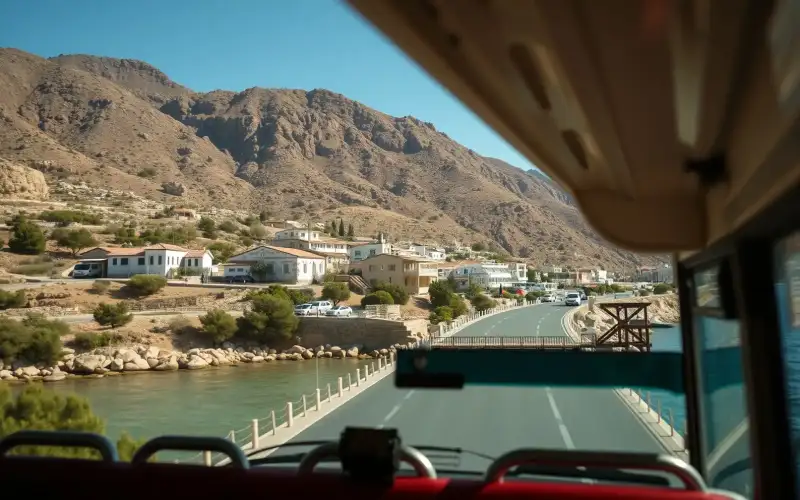
The 610 route connects Paphos with Polis and Latchi, running along the scenic road that hugs the Akamas Peninsula's eastern edge. This is perhaps the most rewarding journey for slow travellers. The route takes around 90 minutes, winds through villages like Androlikou and Neo Chorio, and costs €3.50 per journey. Services run roughly three times daily in high season, dropping to two in winter months. I've spent entire afternoons simply riding this route, watching the landscape shift from suburban sprawl to genuine countryside.
For shorter journeys within Paphos itself, the local buses are more frequent, with the 7 and 8 routes covering most of the town and connecting to the beach areas. These run every 20 to 40 minutes and cost €1.50 per journey.
The Gaps in the System
What the network doesn't do is reach the smaller villages with any regularity, or connect the outlying beaches and nature reserves on convenient schedules. If you want to visit Akamas Peninsula properly—to hike to Lara Beach or explore the Blue Lagoon—you're dependent on either a car or an organised tour. The local minibuses that serve villages like Kritou Terra or Pano Panagia run mainly for residents commuting to work, not tourists. A bus might arrive at 7:15 in the morning and not return until 4 in the afternoon.
This is the first honest reckoning: public buses work for getting between towns, not for exploring the countryside that makes this region special.
Taxis: The Middle Ground Nobody Talks About
What visitors often overlook is the shared taxi system—known locally as service taxis—which occupies a strange middle ground between buses and private hire. These are typically white minibuses that run set routes but will pick up and drop off passengers anywhere along the way, not just at fixed stops.
From Paphos, shared taxis run to Polis (€4.50), Latchi (€5), and even further afield to Larnaca and Limassol. They leave when they're full rather than on a set schedule, which can mean anywhere from 10 minutes to 45 minutes of waiting. The advantage is flexibility; you're not bound to a timetable. The disadvantage is unpredictability. I once spent two hours waiting for a shared taxi to Polis because the driver was waiting for one more passenger who never materialised. Eventually I paid a small premium to leave immediately with just four of us in the vehicle.
The shared taxi system works best if you're not in a hurry, if you speak a bit of Greek (or have the Bolt app, which also covers taxis), or if you're staying long enough to learn which drivers work which routes at which times. There's a certain charm to the inefficiency—you meet locals, you hear stories, you become part of the fabric rather than a tourist passing through. But it requires patience that not everyone possesses.
When Organised Tours Become Essential
Let's be frank: if you want to experience the Akamas Peninsula properly, you need either a car or a tour. The peninsula is protected, access is limited, and the best experiences require local knowledge. There are several tour operators based in Paphos offering half-day and full-day trips to the Blue Lagoon, Lara Beach, and the various hiking trails. Prices typically range from €45 to €90 per person, depending on what's included.
What Tours Offer That Independent Travel Doesn't
A good tour does more than simply transport you. It provides context. When I took the Akamas Wildlife Tour with a local guide named Nicos last spring, he pointed out plants I'd walked past a hundred times without seeing—the Cyprus orchid, endemic to just a few hillsides, flowering for only two weeks a year. He knew where to find the loggerhead turtles nesting at Lara Beach in June. He could navigate the rough tracks into the interior in a way that would have taken me hours to figure out independently.
Tours also solve the logistics problem. Getting to the Blue Lagoon without a car requires either a boat trip from Latchi (which runs seasonally, €20-30) or joining an organised excursion. For many travellers, this is the most convenient option.
The trade-off, of course, is that you're moving in a group, on a fixed schedule, with predetermined stops. If you want to linger somewhere for an extra hour, or take a different path, or discover something on your own, the tour structure prevents that. It's a different kind of travel—less flexible, but often more enriching in unexpected ways.
The Real-World Scenario: Three Days Without a Car
Let me paint a realistic picture of what three days exploring the Paphos region actually looks like without a car. This isn't a best-case scenario; it's what I've actually seen visitors accomplish.
Day One: Paphos Town and Coral Bay
You arrive at Paphos airport and take a pre-booked shuttle (€15-20) to your hotel in town. Day one, you explore Paphos itself—the Tombs of the Kings, the harbour, the museums. Everything is walkable or a short bus ride away. In the afternoon, you take the 601 bus to Coral Bay, arriving around 4 pm. You swim, watch the sunset, take the 602 back around 7 pm. Total transport cost: €5. This day works perfectly without a car.
Day Two: Polis and Latchi
You catch the 610 bus from central Paphos at 9:30 am, arriving in Polis around 11 am. You have lunch, explore the town's narrow streets, visit the small museum. At 2 pm, you take a local minibus (€1) the five kilometres to Latchi. You spend the afternoon at the beach or in one of the harbourside restaurants. At 5 pm, you face a choice: catch the last bus back to Paphos (arriving 7 pm), or take a taxi. Most people take a taxi at this point, costing €15-20. This day is possible, but requires planning and clock-watching.
Day Three: The Akamas Problem
This is where car-free travel shows its limits. Without your own transport, your realistic options are: book a tour (€60-80), arrange a private taxi for the day (€100+), or take the boat trip to the Blue Lagoon from Latchi (€25, but dependent on weather and seasonal operation). Most visitors in this situation book a tour. It's convenient, reasonably priced, and solves the problem neatly. But it's also the least flexible option.
The Deeper Truth About Car-Free Travel in Paphos
After years of living here and watching how different travellers navigate this region, I've come to understand that the question of whether you need a car isn't really about logistics. It's about what kind of traveller you are and what you value.
If you're the kind of person who enjoys sitting in a café for three hours without checking your watch, who can appreciate a village's character even if you can't reach the next village that day, who sees transport delays as opportunities for conversation rather than frustrations—then car-free travel in Paphos is entirely feasible, even rewarding. You'll move slowly, you'll see less territory, but you'll see it more deeply.
If you're the kind of person who wants to maximise your time, see as many places as possible, maintain independence and spontaneity, and follow your own schedule—then you need a car. Not for safety or because the alternatives don't exist, but because the alternatives will feel like constant small compromises.
There's also a middle path: rent a car for two or three days, use buses and taxis for the rest. Many visitors do this successfully, using public transport for the straightforward town-to-town journeys and renting when they want to explore the rural areas or visit multiple small villages in a single day.
Practical Realities Worth Knowing
Let me share some specifics that guidebooks often gloss over:
- Timetables are aspirational. The posted bus times are accurate maybe 70% of the time. Delays of 10-20 minutes are normal. Plan accordingly and don't schedule tight connections.
- English speakers are common among younger drivers and in tourist areas, but less so on rural routes. Download Google Translate and have your destination written down in Greek.
- Afternoon siesta is real. Many shops and services close 1-4 pm. Plan your journeys around this, not against it.
- Taxis from your hotel are significantly more expensive than flagging one on the street. A trip from Paphos to Coral Bay costs €12-15 from the street, €25-30 booked through your hotel.
- Winter schedules are dramatically reduced. If you're travelling November to March, bus frequencies drop by 30-50%. This matters.
My Own Evolution on This Question
When I first moved to Paphos eight years ago, I bought a car within a week. I was frustrated by bus schedules, impatient with waiting, eager to explore independently. I drove everywhere, often alone, seeing a lot but experiencing very little. After a year, I sold it. The car had made me feel independent, but it had also isolated me. I was always driving past the everyday life of the region rather than being part of it.
Now I use buses regularly, sometimes taxis, occasionally rent a car for specific purposes. I've discovered that the limitations of car-free travel have forced me to know this region in a way that driving never did. I've learned the names of bus drivers, discovered restaurants because I had time to wander while waiting for a connection, made friends because I was sitting next to them on a shared taxi for 90 minutes.
This doesn't mean car-free travel is objectively better. It's just different. And for the kind of traveller who comes to Paphos seeking the slower side of Cyprus, the slower way of getting around might be exactly what you came for, even if you didn't realise it.
Making Your Decision
Before booking a car, ask yourself honestly: Do I want to move quickly and independently, or slowly and embedded in local rhythms? Both are valid. The bus and taxi network in Paphos supports the second approach quite well. For the first, you'll be frustrated without a car.
Consider renting for just two or three days to explore the Akamas and smaller villages, then relying on public transport for the rest. Consider staying longer in fewer places rather than trying to see everything. Consider that missing one attraction might mean gaining something unexpected instead.
The Paphos region rewards slow travel. The question isn't whether you can get around without a car. The question is whether you're ready to travel at the pace the region prefers.
Comments (4 comments)