
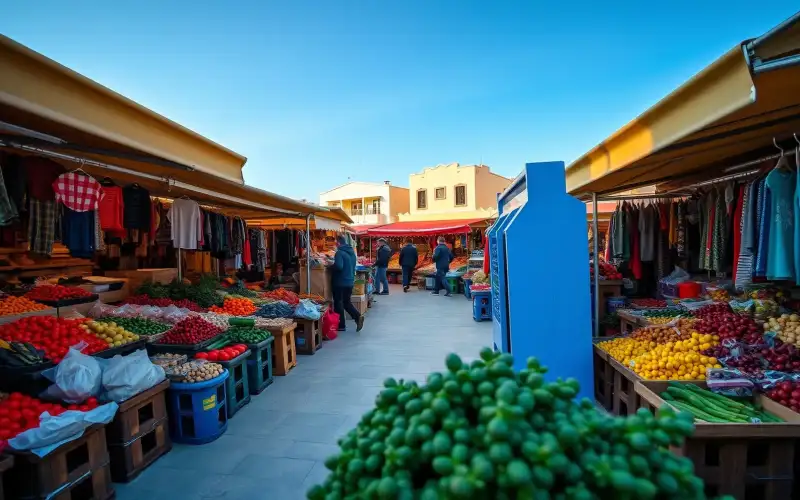
I watched a woman in a navy headscarf negotiate the price of aubergines at 6:47 a.m. on a Tuesday in Paphos market. She wasn't haggling for sport. She knew exactly what those vegetables cost last week, the week before, and probably the week before that. She also knew the vendor's daughter had just started university in Nicosia, and that his knees had been playing up in the damp weather. The negotiation took four minutes. The price dropped by twenty cents. Everyone walked away satisfied.
This is the Paphos market experience that tourists rarely witness—not the sanitised version they find in guidebooks, but the real choreography of Cypriot shopping, where economics and human connection intertwine so tightly you can't separate them.
The Paphos Central Market: Where the Day Begins
The Paphos Central Market, officially known as the Agora, sits in the old town just off Gladstone Street. If you arrive after 8 a.m., you've already missed the best of it. The serious shopping happens between 6 and 7:30, when the light is still grey-gold and the vendors are arranging their displays with the precision of museum curators.
The market operates six days a week, closed Sundays. Monday through Saturday, you'll find produce stalls, meat counters, fish vendors, and a small section dedicated to household goods and cheap clothing. The produce section occupies the northern half of the covered market hall—a concrete structure that's been there since the 1970s but somehow feels timeless.
What strikes first-time visitors is the sheer specificity of what's available. In early 2026, the spring season brings wild greens (horta) bundled loosely in plastic bags—dandelion, amaranth, and others I still can't name despite a decade of asking. A bunch costs between €0.80 and €1.50 depending on the vendor and your negotiating confidence. Tomatoes, when in season (May through October), run €0.60–€1.20 per kilo. Courgettes, peppers, and aubergines follow similar pricing patterns, dropping in price as supply peaks and rising sharply as the season ends.
The fish counter merits its own pilgrimage. Yiannis, who's been selling fish at the Agora for thirty-two years, arrives at 4 a.m. with his catch from Paphos harbour. His display changes daily depending on what the boats brought in. Expect to pay €8–€14 per kilo for fresh white fish, €12–€18 for grouper or sea bass, and €6–€9 for squid. He'll clean your fish on request, no extra charge. I've watched him filet a sea bream in forty seconds while simultaneously conducting a conversation about his grandson's football match.
The Meat and Cheese Quarter
The butchers occupy the eastern corner. This is where you'll find lamb, pork, chicken, and occasionally goat meat—the latter appearing sporadically depending on local demand and seasonal availability. Prices hover around €8–€12 per kilo for lamb, €5–€8 for chicken, and €7–€10 for pork. The butchers here cut to order and take genuine pride in their work. Ask for specific cuts and they'll accommodate you, explaining how each piece suits different cooking methods.
Adjacent to the meat stalls, the cheese vendors sell local halloumi, feta, and occasionally graviera. A kilo of fresh halloumi costs €6–€8, feta €5–€7. These prices are significantly lower than supermarket equivalents, and the quality difference is noticeable—the halloumi squeaks between your teeth, the feta crumbles properly, neither tastes like it was packaged three weeks ago.
Ktima Market: The Saturday Social Hub
If the Central Market is where Paphos shops out of necessity, Ktima Market is where it shops for pleasure. Located in the Ktima district (roughly 2 kilometres north of the seafront), this outdoor market operates Saturday mornings only, 7 a.m. to 1 p.m. The atmosphere is fundamentally different—more relaxed, more social, less purely transactional.
Ktima Market sprawls across a large open area with vendors arranged in loose rows. You'll find many of the same produce vendors who work the Central Market during the week, but here they operate in a different rhythm. Families browse together. People stop for coffee at the small café that sets up near the entrance. Vendors chat with neighbours. The pace is slower, the haggling more theatrical.
The produce quality matches the Central Market, but the selection sometimes differs. Ktima draws more small-scale farmers and home producers, so you're more likely to find unusual items—fresh herbs bundled with roots still attached, honey in unmarked glass jars, eggs from someone's backyard chickens. Prices are marginally higher than the Central Market (perhaps 10–15 percent), reflecting the smaller scale and the social nature of the transaction.
The Local Producers Section
This is where Ktima distinguishes itself. Beyond the standard produce, you'll find vendors selling homemade loukoumades (honey puffs), fresh bread from small bakeries, olives in various states of cure, and occasionally preserves or jams made by elderly women who've been doing this for forty years. A jar of homemade spoon sweets (glyka tou koutaliou)—fruit preserves served to guests—might cost €3–€5, depending on size and ingredients. These items rarely appear in the Central Market because they're produced in small quantities by people for whom this is a weekend activity, not a livelihood.
The Harbour Markets: Fresh Catch and Tourist Crossover
Paphos Harbour has undergone significant development in recent years, and the fish market that operates here represents a different category entirely—more tourist-friendly, more expensive, but also more convenient if you're staying near the waterfront.
The fish vendors here sell the same catch as the Central Market vendors, but at a 20–30 percent markup. A kilo of white fish might cost €10–€14 instead of €8–€10. The trade-off is convenience, extended hours (many operate until 2 p.m.), and an environment that feels less intimidating to visitors unfamiliar with market culture. If you're staying in Coral Bay or the immediate Paphos tourist zone, the harbour market is worth visiting simply for the experience of seeing the boats unload, even if you choose to buy elsewhere.
Seasonal Rhythms: What to Expect Month by Month
Understanding Paphos markets requires understanding seasons. The produce available in January bears almost no resemblance to what you'll find in July, and prices fluctuate accordingly.
| Season | Key Produce | Price Range (per kilo) | Best Markets |
|---|---|---|---|
| January–March | Citrus, leafy greens, root vegetables | €0.60–€1.20 | Central Market, Ktima |
| April–June | Tomatoes, peppers, courgettes, wild greens | €0.60–€1.50 | All markets peak |
| July–September | Melons, grapes, late tomatoes, aubergines | €0.50–€1.00 | Central Market (best selection) |
| October–December | Pomegranates, citrus returning, root vegetables | €0.80–€1.40 | Central Market, Ktima |
Spring (April–June) and early autumn (September–October) offer the most variety and the best prices. If you're visiting during these windows, you'll find the markets at their most vibrant. Winter (January–March) brings lower prices on citrus and greens but less overall variety. Summer (July–September) is peak tourist season, and while produce is abundant, prices can be slightly elevated due to demand.
The Unwritten Rules: How to Shop Like a Local
The Central Market operates on conventions that aren't written anywhere but are understood by everyone who shops there regularly. Understanding them makes the experience less awkward and often results in better prices.
Arrive early. The best produce sells quickly, and vendors keep their best stock for the morning rush. By 8:30 a.m., the selection has visibly diminished. By 9 a.m., you're picking from what remains.
Inspect everything. Vendors expect you to touch produce, squeeze tomatoes, check for soft spots on fruit. This isn't considered rude; it's considered sensible. Pick items carefully and put back anything that doesn't meet your standards.
Negotiate, but reasonably. The woman negotiating over aubergines at 6:47 a.m. wasn't trying to steal from the vendor. She was engaging in a conversation about value. If you're buying multiple items or larger quantities, a polite


Comments (3 comments)