
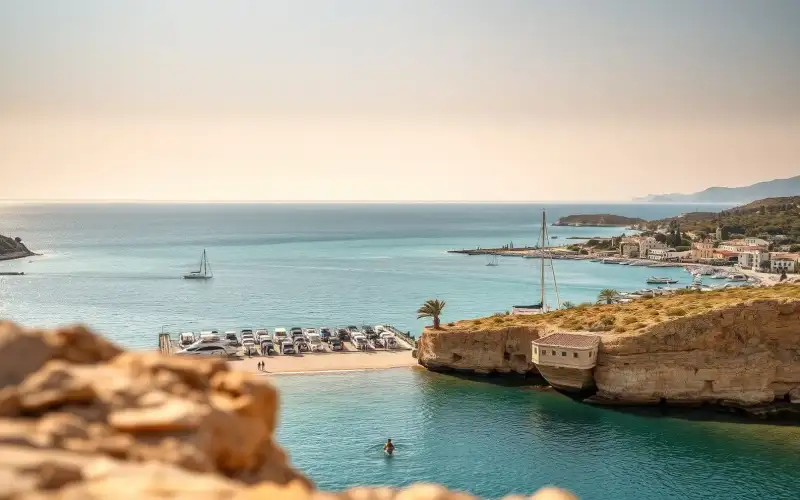
A few years ago I was sitting at a table outside a small meze restaurant on the Paphos Harbour front, watching a pelican — the town's unofficial mascot — wander between the tourist chairs with the confidence of a man who owns the place. At the next table, a couple from Cheshire were debating whether they'd made the right call staying in Paphos town rather than Coral Bay, where their friends had rented a villa. The friends, it turned out, were having a perfectly fine time. But they kept driving down to the harbour for dinner.
That conversation stuck with me. Because the Coral Bay versus Paphos Harbour question isn't really about which place is better. It's about which version of a Cyprus holiday you actually want. And in 2026, with the region's accommodation scene more varied than it's ever been, the answer matters more than ever.
Two Places, One Coastline
Coral Bay and Paphos Harbour are separated by roughly 12 kilometres of coast road — the B7, if you're navigating — and by something considerably harder to measure in miles. Coral Bay is a purpose-built resort strip that grew up around one of the most reliably beautiful sandy beaches on the island. Paphos Harbour, properly called Kato Paphos, is the old lower town: a UNESCO World Heritage zone with Roman mosaics beneath its feet, a medieval fort at the end of the quay, and a waterfront that has been drawing travellers since the Byzantines were in charge.
Both are within the broader Paphos municipality. Both are served by the same airport, roughly 15 kilometres to the south-east. And both attract a significant number of British visitors — Cyprus remains one of the most popular long-haul destinations for UK travellers, and Paphos handles the lion's share of that traffic. But the daily rhythm of life in each place is quite different, and getting that choice right can make the difference between a holiday that feels exactly right and one that leaves you wondering what you missed.
Coral Bay: The Beach-First Base
The Beach Itself
Let's be honest about why people choose Coral Bay: the beach. The main arc of sand — sheltered, Blue Flag, with water that runs from pale turquoise at the shallows to a deeper cobalt further out — is genuinely one of the finest on the island. In July and August it fills up by 10am, but arrive before nine with a book and a bag of pastries from the bakery on the main road and you'll find it manageable even at the height of summer. The sea here is calm, the bottom is sandy rather than rocky, and the whole bay faces roughly south-west, which means afternoon light falls on it beautifully.
There's a second, smaller beach just around the headland — locals call it the back beach — that sees far fewer visitors and where the snorkelling over the rocks is surprisingly good. Families with younger children tend to prefer the main bay. Couples looking for a quieter afternoon tend to find their way around the point.
Accommodation at Coral Bay
The accommodation in Coral Bay runs from large all-inclusive hotels — the Coral Beach Hotel and Resort is the dominant property, with around 400 rooms and a full spa — down to small apartment complexes and self-catering studios that line the streets behind the beach. Prices in 2026 for a decent apartment within five minutes' walk of the sand start at around £65–£80 per night in May or October, rising to £110–£140 in peak July and August. The Coral Beach itself commands considerably more: expect to pay £180–£250 per night for a sea-view room in summer.
What Coral Bay lacks is boutique character. The architecture is functional rather than beautiful. The streets behind the main beach road are a mix of apartment blocks, car hire offices and supermarkets. If you're the kind of traveller who wants to feel embedded in a place — who wants texture in the walls and a sense that the building you're sleeping in has a history — you may find Coral Bay a little thin.
Eating and Drinking
The restaurant strip along the beach road is longer than it looks from a distance. There are perhaps 20 or 25 places to eat within easy walking distance of the main beach, ranging from full taverna menus to pizza and fast food. Quality is variable. The better options — and I'd point you towards the handful of fish tavernas at the northern end of the strip — do a reasonable job with grilled sea bream and octopus. The house wine is invariably Cypriot and invariably fine.
What you won't find in Coral Bay is the kind of serious restaurant that rewards a long dinner. The atmosphere is convivial and informal, which suits many people perfectly well. But for a special evening, most visitors end up driving or taking a taxi down to Paphos Harbour — which rather makes the point.
Getting Around from Coral Bay
Coral Bay sits at the southern edge of the Akamas Peninsula, which is both a blessing and a slight inconvenience. The blessing: you are 10 minutes from the Akamas National Park, the Blue Lagoon boat trips, and the Avakas Gorge trailhead. The inconvenience: you are 12 kilometres from Paphos town, and without a hire car, that journey depends on the 615 bus, which runs roughly every 30–40 minutes during the day and stops in the early evening. A taxi costs around €15–18 each way in 2026. Most people staying in Coral Bay hire a car, and honestly, for this part of Cyprus, that's the right call.
Paphos Harbour: The Town-Centre Base
The Harbour and Its Atmosphere
Kato Paphos is not a beach resort in the conventional sense, though there are beaches — the long strip of Paphos Municipal Beach runs east from the harbour, and the smaller Lighthouse Beach sits just to the west. Neither will win prizes for sand quality. The water is clear, the sun is relentless, and you can absolutely spend a day on a sunbed here. But if you've come to Paphos Harbour primarily for the beach, you've slightly missed the point.
What the harbour area offers instead is atmosphere, history and a genuine sense of place. The Paphos Archaeological Park — home to the famous Roman mosaic floors depicting scenes from Greek mythology — is a 10-minute walk from the waterfront. The medieval Paphos Fort sits at the end of the breakwater. The old Byzantine church of Agia Kyriaki Chrysopolitissa is five minutes inland. You can, if you're organised, spend three or four days here without exhausting the cultural content, and that's before you've driven up to the Tombs of the Kings or taken the road north towards Polis and the Troodos foothills.
Accommodation at Paphos Harbour
The accommodation landscape around Kato Paphos has changed noticeably in the last few years. The large resort hotels — the Almyra, the Annabelle, the Elysium — remain the dominant presences, and they are genuinely excellent: the Almyra in particular has a contemporary design sensibility and a pool that sits almost on the waterfront. Rates for a standard room at the Almyra in 2026 run from around £160 per night in spring to £280–£320 in peak summer.
But there are now smaller, more characterful options. A number of restored townhouses and boutique guesthouses have appeared in the streets just back from the harbour — the area around Apostolou Pavlou Avenue and the old market quarter. These offer 8–15 rooms, often with rooftop terraces and a more personal kind of service. Prices are typically £90–£150 per night depending on season. For the kind of traveller who reads this site — who wants something slower, more considered, more rooted in place — these are worth seeking out specifically.
Dining and Evening Life
The harbour front itself is, let's be candid, a tourist strip. The restaurants that line the quay are aimed squarely at visitors, and the menus reflect that: English breakfasts, pizza, fish and chips alongside the Cypriot staples. Some of these places are perfectly decent. None of them are particularly interesting.
The better dining in Paphos Harbour requires walking five minutes off the waterfront. The streets immediately behind the Archaeological Park contain several restaurants that take their food seriously — places where the meze is built around what came in that morning, where the bread is made in-house, and where the owner is likely to come and talk to you about the wine. I've had some of the best slow lunches of my life in this part of town: a two-hour affair of hummus, grilled halloumi, lamb kleftiko and a carafe of Commandaria, watching the afternoon light thicken over the mosaics through the restaurant window.
The evening atmosphere in Kato Paphos is livelier than Coral Bay but not aggressively so. There are bars, there is music, there are groups of people having a good time. But it doesn't tip into the kind of late-night chaos that characterises Ayia Napa or even parts of Limassol. By midnight, most of the harbour front is quiet.
Getting Around from Paphos Harbour
The practical advantage of staying in Kato Paphos is walkability. The Archaeological Park, the fort, the lighthouse, the Municipal Beach, the old market — all of these are on foot. The bus connections to Paphos town centre (Ktima) and to the airport are regular and cheap: the 610 and 615 routes both serve the harbour area, and a single fare is €1.50. For Coral Bay and the Akamas, you'll still want a hire car or be prepared for the bus journey, but the harbour base gives you more to do without one.
The thing about staying in Kato Paphos is that you can have a genuinely full day without getting in a car at all. That's rarer in Cyprus than you might expect, and for a certain kind of traveller, it's worth a great deal.
Side-by-Side Comparison
| Factor | Coral Bay | Paphos Harbour |
|---|---|---|
| Beach quality | Excellent — Blue Flag sandy bay | Moderate — shingle and sand mix |
| Cultural interest | Low — resort strip | High — UNESCO mosaics, fort, churches |
| Restaurant quality | Good casual dining; limited fine dining | Better range; excellent off-strip options |
| Evening atmosphere | Relaxed, quiet after 10pm | Lively but not rowdy; varied |
| Walkability | Low — car recommended | High — most sights on foot |
| Akamas access | Excellent — 10 mins by car | Good — 25 mins by car |
| Boutique accommodation | Limited | Growing selection |
| Typical peak price (double room) | £110–£250 per night | £150–£320 per night |
| Airport distance | ~18km (25 mins) | ~15km (20 mins) |
| Best for | Beach-focused, families, Akamas explorers | Culture, slow travel, couples, foodies |
Who Should Choose Which
The honest answer is that the right base depends almost entirely on what you want to do with your days.
If your ideal Cyprus morning involves walking to the beach in flip-flops, spending four hours in the water, and eating grilled fish at a table 20 metres from the sea, Coral Bay will make you very happy. It does exactly what it promises, and it does it well.
If, on the other hand, you want to spend a morning wandering the Roman mosaics, take a long lunch somewhere off the tourist trail, and have the option of an evening that involves something more than the beach-bar circuit — Paphos Harbour is the better base. It's also the better choice if you're travelling as a couple rather than a family, if you're interested in Cypriot food and wine rather than just convenient calories, and if you prefer the feeling of being in a place with some history to it.
There's a third option worth mentioning, which is to split the difference. A number of visitors I've spoken to over the years have done exactly this: two or three nights in Kato Paphos at the start of the trip, absorbing the culture and the harbour atmosphere, then moving to Coral Bay for the second half and using it as a base for Akamas day trips. It requires a bit more organisation, but it's a genuinely satisfying way to see both sides of this stretch of coast.
- Choose Coral Bay if: you want a great beach as your daily anchor, you're travelling with children, you plan to spend significant time in the Akamas Peninsula, or you prefer an all-inclusive setup.
- Choose Paphos Harbour if: you want cultural depth alongside your beach days, you prefer boutique or design hotels, you're a couple looking for good restaurants and evening atmosphere, or you'd rather not rely on a hire car every day.
- Consider splitting your stay if: this is your first visit to the region and you want to understand both sides of it — the ancient town and the modern resort — before deciding where you'd return to.
One last thing. The couple from Cheshire I mentioned at the start — they came back the following year and stayed in Kato Paphos. Their friends from Coral Bay came down to join them for dinner on the harbour front. Everyone, it turned out, was happy. Cyprus has that effect on people.



Comments (7 comments)