
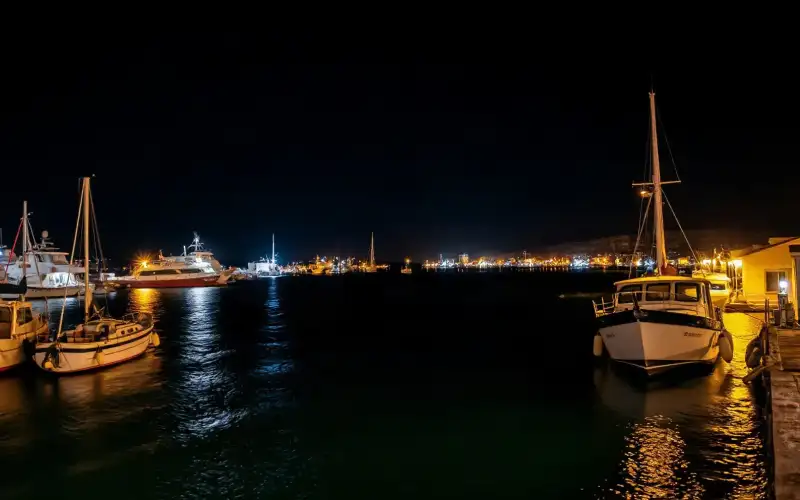
I arrived at Latchi harbour on a Thursday evening last September expecting the usual Mediterranean cliché—fairy lights, cocktail menus, British accents. What I found instead was a seventy-year-old man called Yiannis hauling nets from a wooden boat while his wife set tables for dinner fifty metres away, and a cluster of locals nursing Keo beers on plastic chairs, entirely unbothered by the three of us tourists standing awkwardly near the water's edge.
That moment—the gap between what travel guides promise and what actually happens when the sun goes down in Latchi—is the whole story. This small fishing harbour on Cyprus's northwest coast, roughly forty minutes from Paphos town, has somehow escaped the homogenisation that's swallowed so many Mediterranean ports. The bars here aren't designed for tourists. They evolved for the people who work the boats and live in the surrounding villages. That's precisely why British travellers seeking something genuine should be drinking here.
Overview: The Real Latchi After Dark
Latchi isn't Ayia Napa. It's barely even a town—more a cluster of tavernas, a working fishing fleet, and a handful of family homes arranged around a shallow harbour that's been in use for centuries. The evening economy here runs on a different logic than the purpose-built resort bars of Paphos or Limassol. These aren't venues designed by marketing teams. They're businesses that happen to serve alcohol because fishermen and locals need somewhere to sit after work.
The harbour itself becomes the social spine after dark. By 8 p.m., the fishing boats are moored and lit by single bulbs. Families begin arriving for dinner. By 10 p.m., the tavernas have shifted into a different gear entirely—louder, more animated, occasionally with live music spilling out onto the waterfront. By midnight, you'll find clusters of locals in their fifties and sixties still nursing drinks, while younger Cypriots from Polis (the larger village five kilometres inland) drift in and out.
The key distinction: you don't come to Latchi for cocktails or DJ sets. You come for wine, local spirits, cold beer, and the particular kind of evening that unfolds when a place has no agenda beyond people wanting to spend time together. The bars stay open late—often until 1 or 2 a.m.—but there's no artificial energy, no push toward consumption. You can sit for two hours over a single glass of Cypriot white and nobody will hurry you.
The Tavernas That Turn Into Music Venues
Where the Fishermen Actually Eat
Taverna Latchi sits directly on the waterfront, its tables arranged so close to the water you could theoretically drop cutlery into boats. It's run by a family that's been in the fishing business for two generations, and the evening menu reflects that entirely—fresh grilled fish, meze plates, saganaki (fried cheese), nothing complicated. A main course of grilled sea bream runs €14–18. Wine is €3–5 per glass from local producers you won't find in British supermarkets.
What makes it worth mentioning isn't the food—though it's genuinely excellent—but what happens after 10 p.m. An older man with a bouzouki sometimes appears. Not as scheduled entertainment. He just shows up, sits at a table, and starts playing. Other locals join in. By 11 p.m., there's informal music happening, people singing in Greek, and a particular kind of warmth that only emerges when nobody's performing for an audience.
I watched this unfold in September. A woman in her sixties was dancing—properly dancing, not the self-conscious swaying you see in tourist bars—while her husband and three other men clapped in rhythm. Nobody was filming it. Nobody was performing. It was just what happened on a Thursday night in Latchi.
The Quieter Waterfront Tables
If Taverna Latchi feels too animated, there are three or four smaller spots scattered along the harbour's edge where the energy is calmer. These aren't named establishments in the conventional sense—they're often just a family's house with tables outside, operated informally. One is run by a woman called Maria who serves only wine and meze (€2–4 per plate). Another, tucked behind a small fishing supply shop, has perhaps six tables and serves the same wine, same meze, same unhurried atmosphere.
These places don't appear in guidebooks because they have no websites, no social media, no English menus. You find them by walking along the harbour at dusk and asking where the locals are drinking. The answer is usually one of these informal spots, where the clientele is almost entirely Cypriot, the conversation is entirely in Greek, and the evening unfolds at a pace that feels genuinely relaxed rather than curated.
The Wine Bars Behind the Waterfront
Where to Find Proper Cypriot Wine
Set back from the harbour, maybe a hundred metres inland, are two or three small wine-focused bars that cater to a slightly different crowd—locals with disposable income, visiting wine enthusiasts, the occasional expat from Polis. The most established is run by a man called Christos, who spent fifteen years working in wine distribution before opening his own place around 2019. His bar stocks perhaps thirty Cypriot wines, most from small producers in the Troodos mountains or the Akamas region.
A glass of quality Cypriot white—something like a Xynisteri from a boutique producer—costs €5–7. A bottle runs €18–28. These aren't London prices, but they're not cheap either. The clientele reflects that: locals who take wine seriously, British expats from the surrounding villages, the occasional visiting wine merchant or food writer. The bar itself is deliberately understated—wooden tables, good lighting, no music, conversation-friendly.
Christos can talk for forty minutes about the differences between Cypriot and Greek wine production, or about which producers are experimenting with natural fermentation. He's the kind of bar owner who makes the evening feel like a genuine social exchange rather than a transaction. On a quiet Tuesday, you might be one of three customers. On a Friday, it fills with regulars who've been coming for years.
The Neighbourhood Spots Worth Finding
Walk five minutes uphill from the harbour and you'll find yourself in the actual village of Latchi—a cluster of houses, a small church, a grocery shop. There are two or three bars here that serve the people who actually live in Latchi rather than work in the tourist infrastructure. One has a small garden with lemon trees. Another is basically someone's front room with a drinks fridge. These are places where a Cypriot pensioner might spend an evening with friends, drinking coffee or beer, watching football on a TV mounted in the corner.
The experience is fundamentally different from the waterfront tavernas. There's no view, no theatrical backdrop, no sense of performing tourism. It's just people in a room, doing what they do most nights. For British travellers genuinely interested in how Cypriots spend their time, these neighbourhood bars offer something guidebooks can't: authenticity that isn't packaged as authenticity.
What to Drink and How Much It Costs
The local beer is Keo, a lager that's been brewed in Cyprus since 1927. A 330ml bottle costs €2–3 in any bar. It's light, cold, and perfectly adequate—not craft beer, not trying to be anything other than what it is. The alternative is Carlsberg or imported European lagers, which cost slightly more.
Wine is the more interesting category. Cypriot wine production has improved dramatically in the past fifteen years, particularly from smaller producers in the Troodos region. A house white or red in a taverna costs €3–5 per glass or €10–15 per bottle. If you're willing to pay €18–25 for a bottle, you can access genuinely good local wine—producers like Ktima Gerolemo, Domaine Eftakoili, or smaller operations that distribute only locally. Ask the bar owner for recommendations. Most will have strong opinions.
The traditional spirit is brandy—usually Cypriot brandy, which is sweeter and heavier than European equivalents. A shot costs €2–3. There's also ouzo (anise-flavoured, €2–3 per shot) and occasionally raki, a fiercer spirit that appears in more traditional establishments. Nobody drinks these casually. They're typically ordered as a digestif after dinner or as part of a particular social ritual.
A reasonable evening—dinner, a bottle of wine, perhaps a spirit afterward—costs €25–40 per person in a taverna. In the wine bars, you might spend €15–25 on wine and snacks alone, depending on what you choose. Either way, it's substantially cheaper than equivalent evenings in Paphos town.
Who It's Actually For
Latchi after dark works for travellers who've moved past the resort-bar phase of their lives. You need to be comfortable with Greek being the primary language, with menus that might not exist in English, with the possibility that your evening might unfold according to local rhythms rather than scheduled entertainment.
It's excellent for couples in their fifties and sixties seeking something beyond the typical package-holiday experience. It works for people interested in wine, in authentic Mediterranean culture, in understanding how ordinary Cypriots spend their time. It works for families with older children who want to eat dinner in a real setting rather than a themed restaurant.
It doesn't work if you're seeking nightlife in the conventional sense—DJ sets, dancing, cocktails, the energy of a purpose-built club. Latchi has none of that. It's quiet by design, not by accident. The loudest it gets is when locals are singing, which is spontaneous rather than scheduled. If you need entertainment provided to you, this isn't the place.
Practical Logistics
Latchi is accessible by car from Paphos (roughly forty minutes via the E701 and local roads) or by bus—the OSYPA service runs a few daily routes from Paphos town to Polis, with a stop near Latchi. Parking is straightforward; there's a small car park near the harbour entrance, and street parking is available.
Most bars open around 6 p.m. and stay open until midnight or later. Tavernas typically serve dinner from 7 p.m. onward. There's no particular
Comments (0 comments)
No comments yet — be the first!